What ERG mode does
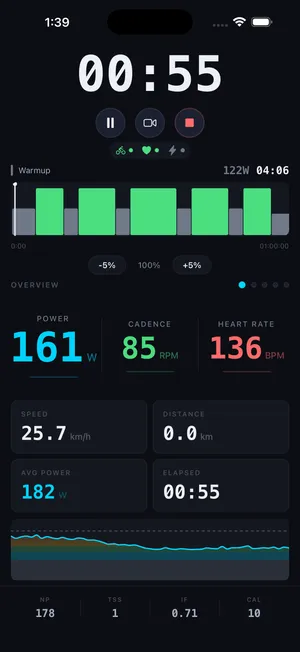
A structured workout is a list of power targets: five minutes at 210 watts, then a minute at 300, and so on. In ERG mode the trainer reads each target and changes its own resistance to keep you there. If you spin faster it eases off; if you grind slower it pushes back. Your job is to keep turning the pedals — the watts are the trainer's problem.
Without it you are chasing a number on the screen by feel, and a five-minute block at 250 watts comes out as a sawtooth somewhere around 250. With it, you ride the workout as written.
How CrankPilot drives it
CrankPilot talks to the trainer over Bluetooth FTMS, the standard most smart trainers speak. When the workout steps to a new block, the new target goes to the trainer and the resistance moves within a couple of seconds. Between the warm-up and the cool-down you do not touch anything.
Adjusting on the fly
Some days the plan is optimistic. Two controls fix that without leaving the ride screen:
- Intensity in 5% steps. Bump the whole workout up or down a notch when a block is harder or easier than it should be. The shape of the session stays; only the level moves.
- Zwift Ride paddles. If you ride the Zwift Ride controller, its paddles nudge the ERG target up and down mid-interval, so you never reach for the phone.
Resistance and grade, when you want them
ERG is the default for structured work, but it is one of three modes, switchable mid-ride:
- ERG — the trainer holds a watt target. The mode for intervals.
- Resistance — you set a fixed resistance level and your power follows your effort, like a fixed gear on a hill. Good for a free spin or a sprint.
- Simulation (grade) — the trainer mimics a road gradient, so a 6% climb feels like one. This is where virtual gears come in.
Where ERG goes wrong
ERG needs a trainer that accepts control commands. A classic wheel-on unit with a fixed resistance curve will pair as a power source but will not hold a target. And near the end of a hard interval, if your cadence drops too far, the trainer has to raise resistance to hold the watts, which drops your cadence further. Spin lighter and faster as you fatigue, or drop the intensity a step, and you stay out of that corner.